Saturday, 2 February 2013

To the Memory of Gamal al-Banna (1920-2013)

-->

Gamal al-Banna at his office 14 June 2012

When I walked out of the office at Sharia al-Geish on 14 June 2012, something had changed. It felt as if a door that seemed eternally open, lost in time and space, irrevocably closed behind my back.

Since our first meeting on 21 August 2007, Gamal al-Banna was one of the personalities who most impressed me and marked my thoughts and life. His office, library and home were situated in the middle of a busy and popular area where taxi drivers usually told me off for not exactly knowing the location and forcing them into the hassle of the overcrowded one-way streets. “Mʿalish, I can walk from here,” I would say and give the driver an extra pound. I found refuge from the honking cars and the burning sun as soon as I entered the old building and tried to control my breath while walking up the stairs. From the door I was guided through a small corridor to the heart of the apartment: Gamal al-Banna’s office.

Very modestly, dressed in what looked like a worker's overall, surrounded by thousands of books sat a man who had dedicated his whole life to thought and only thought. He welcomed me and sat next to me on the green coach. He looked at me with small lively eyes and excused himself for his English. However, his thoughts mastered all kinds of language barriers, the philosopher did not talk in vain, all his words were duly selected, thought through and eloquently referenced by religious or secular sources. He finished by dictating me out of his mind a complete article which did not need further editing.

When talking about his brother Hassan, he referred to him as “Hassan al-Banna” and never as “my brother” and explained to me that the Muslim Brotherhood had been founded mainly for the conduct of religiously based educational and social activities but not for politics. Gamal al-Banna explained to me: “the idea to enter politics, was a new idea and not in accordance with the original goal of the organization. Nevertheless some accident pushed Hassan al-Banna to participate in the elections of 1945. An-Nahhas Pasha, the Prime Minister, explained to the founder of the Muslim Brotherhood that the British refused to have him in Parliament. However, Hassan al-Banna made an agreement with the Prime Minister who granted him the opportunity to organize the Muslim Brotherhood freely. This was a victory for Hassan al-Banna because he was able to spread his ideas all-over the world.”

Gamal al-Banna looked straight into my eyes and added: “I mentioned that to make you understand that politics were not the main interest of the Muslim Brotherhood even though they wanted a Muslim government or at least a government that applied the broad lines in the Quran about politics. These are very similar to the basic concepts of democracy and encompass the refusal of dictatorship, the election of the rulers and the establishment of a decision making process via consultation. The Muslim Brotherhood wanted to apply these not in order to reach power, or to establish the government, no! They wanted these rules to be applied by others, whom they might assist. Why did they not want to govern by themselves? Because it is very dangerous to establish an Islamic State! Because power corrupts religion!”

Intrigued to learn more from this man who had done his utmost in order to remain an independent thinker –even establishing his own publishing house and Islamic cultural foundation– I used each opportunity to meet him for another interview. Gamal al-Banna’s door was always open and he usually told me to come at 10 o’clock in the morning. The last time I met the founder of the International Islamic Confederation of Labour who was at the same time the author of over fifty books about Islamic topics, he looked very tired. Long had he pleaded for reason over blind faith and a re-introduction of Islamic ethics into modern Egyptian society…

Already in 1972, in his book “The Spirit of Islam” (روح الإسلام), Gamal al-Banna argued that the contradiction between social and cultural development and Muslim conservatism arose from the fact that his contemporaries lacked comprehensive knowledge of their religion and therefore attributed an erroneous role to it. After extensively working on questions of labor, he had reached the conclusion that in Islam the true concept of justice can be found. Gamal al-Banna saw Egypt torn between two extremes: superficial Westernism imported by the bourgeoisie and popular conservatism hosted by the Azhar institutions. However the majority of the Egyptians felt represented by neither of them. The modern liberal Egyptian thinker therefore faces, according to Gamal al-Banna, the challenge and the responsibility to unite the faith and ethics of Islam with the modern achievements such as fundamental rights, democracy and contemporary art. Gamal al-Banna added that this union would fairly be difficult if people felt the need to acquire extensive knowledge of their cultural tradition and religion.

During our last meeting I talked with Gamal al-Banna in Arabic, I sensed that I had grown closer to his society, culture and religion over the years. However, I felt him more distant. He was not able to join me on the sofa any longer and his assistant arranged a chair for me next to him behind the table. His words dropped heavily from his old lips and he fell asleep twice. In order not to tire him I decided to leave early. As I walked out my heart did not dare wish to see him again.

Tuesday, 5 June 2012

Balances and Ladders

-->
Very view observers of the presidential elections outside of Egypt may have noticed the little circles which enclose symbols on the propaganda posters of the candidates. These are not mere adornments or amulets for political prosperity but they do have a very pragmatic function: they are meant to facilitate the participation of the around 25% of citizens who can neither write nor read.

Each candidate was therefore free to choose a symbol to represent his name on the lists at the polling stations. The ones that remain for the second round are the ladder for Ahmad Shafiq and the balance for Muhammad Mursi.  Whereas the former seems to promise an accelerated advance of the country straight up to the sky, the latter claims his capacity to balance the different interest down on earth. However, both options seem to convince neither the Facebook-community nor the graffiti activists who keep expressing their discontent about the election results on diverse levels of artistic accomplishment. Fearless they are attacking the two presidential candidates while sarcastically stating that it will be the last time for a long period...

"The Ladder": Ahmed Shafiq


Were the elections really clean? May they be labeled truly democratic? Is it normal that after a popular revolution, which had been able to overthrow a 30 years old regime, less than 50% of the same angry and now self-confident citizens proceed to the polling stations? Is it fair to force people living in disperse locations of the country back to their place of origin in order to fulfill their duty as citizens of a democratic state? Is it not very likely that the poor employee who is working in Luxor cannot travel all the way back to Cairo (more than 12 hours) in order to deposit his vote? What about the analphabets? Did they truly understand where to sign and were they left to proceed without any outer assistance?

"The Balance": Muhammad Mursi


When the High Council of Armed Forces lifted the state of emergency it seemed to push the country up the ladder and into the democratic heaven. A few days later however, the same ruling institution took hold of the legislative power which un-balanced the classic repartition… Nevertheless, the demonstrators do not want to play this kind of “balances and ladders” which seems to be a loosing game for the revolutionaries. This is the reason why they called for another “milliuniyya” (massive demonstrations) on the Tharir Square tomorrow.

Saturday, 31 March 2012

Visual Propaganda in Egypt: the Army and Hazim Abu Ismaʿil

-->
After Mubarak’s demission which marked an end to the first phase of the Egyptian revolution, the army celebrated victory together with the people. Egyptians of all generations took photographs in front of the tanks that had surrounded the Tahrir square allegedly in order to protect the demonstrators. Nevertheless against what exactly the army had come to protect them remains to be freely imagined…

The initially so euphoric glorification of the soldiers as the guardians of the revolution came to an end after multiple scandals. As early as on 9 March 2011, “virginity tests” were perpetrated on the allegedly “protected” female protesters in order to “protect” them even more; namely against the accusation of prostitution. Then certain claims for civil trials of the demonstrators who had been sent to prison at the beginning of the revolution with rapidly improvised military sentences (most probably to “protect” these young people against themselves?!) could be heard in the public sphere. Later on, the events in the Stadium of Port Said and the ferociously suppressed demonstrations in Mohammed Mahmud Street in Down Town (next to the Tahrir Square), made people doubt about the honesty of the army and more and more “NO SCAF”-graffitis appeared on the walls all over the Egyptian capital. 

 
-->"The People and the Army, Hand in Hand!"


Finally, as the artists stopped to eternalize the image of the kind soldiers who distribute flowers to little girls with grinning faces, the army took over the lead in reminding the people that they had “protected” them during the revolution. All the tanks (where one year ago demonstrators had written: “the people want the fall of the system”) now carry the following caption, yellow on purple: “the people and the army, hand in hand!” For the ones who are not able to read –and this is still a big portion of the people who are roaming night and day the Egyptian streets– big posters were produced with a gentle soldier who is cradling a baby in his arms. The spectator, made prisoners of his emotions while looking at this symbol of tenderness, remains unaware of the Kalashnikov which is hanging from the soldier’s left shoulder.

However not only the army started to use visual propaganda posters on the streets in order to attract the attention of the people who are not using Facebook. Although these millions of people might easily be forgotten from an economical point of view, in democratic elections the voice of the most disadvantaged analphabet in the country will also count. Two parties understood this fact very fast: the army and the self-nominated presidential candidate Hazim Abu Ismaʿil.


-->
While Egyptian graffiti-artists are honoring their martyrs on the wall of the old AUC main-building, the grinning face of the presidential candidate Hazim Abu Ismaʿil, stuck to the rear-window of the car in the foreground, is promoting “a decent state and modest people.”


About three weeks ago, the happily smiling face of a man, who for European children looks like dear Father Christmas with his long white beard, started to appear on buses and cars all over Cairo. Far from a religious garment, in his modern suit with a blue tie, this wolf in sheep’s clothing promotes “a decent state (dawla muhtarama) and modest people (shaʿb massun)”. Both attributes are directly related in the Arabic language with this strange kind of honor which in patriarchal societies seems to depend solely on “their” women’s –and here I would like to stress the possessive quality of the pronoun– behavior. In other words: the dominant, religiously immaculate male, Abu Ismaʿil is paradoxically planning to penetrate the state in order to make it become decent. From this point of view his attempts seem somewhat cynically in accordance with the Moroccan penal code that allows the rapist to wed his victim if she is a minor… 

Well anyway, if he wins the elections, dogs and women might start to apply for political asylum somewhere in the “indecent” states which are populated with “heretic” and “immodest” people stereotypically called “the West”.

Monday, 26 March 2012

Demonstrations on the International Day of Drama in Tunis


On 25 Mars 2012, the salafists challenged the liberals in front of the Théâtre Municipal in Tunis. The theatre-workers gathered under the banner: “the people want theatre!” while the salafists assembled in the middle of the street in front of them and chanted: “the people want an Islamic state!”
Meanwhile in the Café l’Univers people were having coffee and watching bearded teenagers passing by who shouted at them: “you heretics!” However, the former turned around calmly, laughed at them and answered back: “yes and you guys are very good Muslims!”


Saturday, 24 September 2011

From Egyptian to Egyptian: Work Is Our Only Solution!

In the past eight months since the revolution already 220 political parties were prematurely delivered out of the void. The revolutionary slogans were partially erased from the walls of the Egyptian cities and replaced by the candidates’ names for the approaching elections.
In Abu Kabir (Sharqiyya) the Muslim Brothers -for the first time in history- proudly marked the balcony of their headquarters with their religiously tinted slogans and logos. They now form the political “Party of Freedom and Justice” (Hizb al-Hurriya wa-l-‘Adala).
Yet they are not the only ones making publicity for their candidates. It is as if a hurricane of political activism had passed through the cities and driven away the Ramadan decoration, which was then immediately replaced with all kinds of painted and printed banderoles and posters with names and faces of people who are sharing the new experience of democracy.
Not all of the gatherings are peaceful. Some days ago, when I drove by the children’s hospital in Old Cairo, I saw a group of men who were decidedly and proudly marching into the opposite direction, armed with two Kalashnikovs in full daylight. Later on, when I mentioned this incident to an Egyptian friend, he laughed and told me that this was completely normal, that everybody had always born arms in that quarter, but that only now “after the revolution” they could display them openly.
In the shadow of the emergency law (which was immediately re-introduced after the destruction of the Israelian embassy) states-employees are struggling for “clean” elections. The struggle is difficult and abstruse, as the newcomers have to fight against a Kafkaesque, stagnant bureaucratic apparatus full of people who in some way or the other were collaborating with the regime and are not planning to step down just because their patriarch had done so. As a matter of fact, today even the latter was rehabilitated at the moment when General Tantawi proclaimed Mubarak as not guilty…
There is one curious political group, which started to anonymously monopolize the beginning of the desert road from Cairo to Alexandria with their huge publicity posters. They read: “From Egyptian to Egyptian: Work Is Our Only Solution!” Standing in the middle of the desert, written in English, white and red on black, the whole of it awkwardly reminded me of the Nazi propaganda “Arbeit macht Frei!” (Work will set you free) placed on the top of a gate which knowingly led to death; the one of the concentration camp of Auschwitz.
Which is the audience that the slogan “Work Is Our Only Solution” triggers? Who is it coming from? From an English speaking Egyptian to an English speaking Egyptian who both have cars and use the Alexandria desert road? Yes, those might be the ones who should start to work in order to change the country! But will they remember and want to share with the 90% of their countrymen who do not talk English, the 80% who do not have cars and the 60% who do not have work? Will they be willing to let them partake in power? And if they are, will the Supreme Council of Armed Forces let them do so? If they are not, this is no social revolution and there will be no democracy!

Saturday, 10 September 2011

Destruction of the Israelian Embassy in the Egyptian Capital


Demonstrators on the Tahrir Square, 9th September 2011

When I met my friend Ahmed (name changed) who was carrying a big hammer on his shoulder while making his way to the Tahrir Square, I first thought he might want to visually express his adherence to the communist ideology. As a matter of fact, I had never discussed party politics with him before and did not really know which part of the political landscape he was actually belonging too. I greeted him with a surprised and joyful “Ezzaiyyak” (how are you), as we had not met for a long time and immediately started to push his leg about his new membership in the workers’ movement. He smiled in the warm light of the setting sun and made me understand that I was very much mistaken. Happily he declared that he wanted to go and destroy the Israelian Embassy. I laughed, weighed the hammer in my hand and did not believe a word of what he said.
In this moment, when the heavy iron lay on my fingers, I was completely unaware of the fact that this instrument might be among the ones which were to force the initial stroke to the outbreak of a major war in human history. Ahmed disappeared among the crowd of demonstrators on the Tahrir Square. 

The (more ore less) weekly gatherings on the famous place of liberation have now turned into a special kind of folk festival where popcorn and jus-sellers make their living. Also salesmen of handy little sowing and shaving equipment gather for the feast and spread out their towels on the floor among the ones who are trading with nationalistic icons. Black and white pictures of Osama Bin Landen are sold next to Nasser’s multiple photographs. People gather in small groups among artists or party-leaders and charismatically scream their message at each other without forgetting to put it into rhyme-prose or to formulate it as a joke (nokta). 

However, later on last night the panorama changed completely and the ones who were following the news on the Al-Jazeera Channel were turned into witnesses of a major transgression of international law. An emotionally overloaded crowd driven by an exaggerated nationalist enthusiasm started to attack the Israeli Embassy in Giza. First the flag fell down from the 40th floor of the high building and suddenly it illuminated the sky in flames. The armed forces, which were “protecting” the building, seemed to have suddenly lost all their powers with which they had threatened the population on television the day before. The youth managed to sack the embassy without major obstacles. Papers were falling from the sky like snow while the flat looked like the open mouth of a fire-spitting, dark dragon. The crowd celebrated and held their stolen trophies to the cameras, completely unaware that they were not the glorious actors but the mere tool of a cruel game of power-policy. One only remains with the Christian task to ask the powerful to forgive these children, as they were innocent and did not know what they were doing…

Friday, 25 March 2011

Pro Mubarak Demonstration


In front of the old main building of the American University in Cairo, a very uncommon demonstration took place this morning. About fifty people displaying big posters of a handsome, radiant Mubarak gathered for a pro Mubarak walk. Even though they were heavily insulted by the people on the streets, they held their heads up high and answered back that in a democracy all opinions had a perfect right to be publicly shown…

Wednesday, 23 March 2011

The Demonstrations Continue

The wind of revolution whistled down the streets of the Cairene down town area again. In the morning, the Shaykhs from the Azhar University organized a protest demonstration in front of the Ministry of Religious Endowments in order to demand the independence of their University and the rest of the Azhar institutions from the state. At the same time, they asked for the right to directly elect the head of those establishments. 
Theologians (shaykhs) from the Azhar institutions protesting in front of the Ministry of Religious Endowments

This demonstration of the most respected Islamic theologians of the country was completely peaceful compared to another one, only a couple of streets further to the south-east. There, the police gathered in order to plead for higher wages and more respect, in front of the generally detested building of the Ministry of Internal Affairs.
This monumental edifice, a symbol of violent power, with its totalitarian aspect always reminded me of George Orwell’s “Ministry of Love” and, as a matter of fact, it seems to have had strangely similar functions under the successive Egyptian authoritarian regimes. This is the reason why nobody seems to have been truly offended that parts of it were set on fire by the protesting police officers. This act may only have brought them closer to the “people of the 25th of January Revolution”.

Tuesday, 22 March 2011

January Stories

“January Stories” is the title of a documentary drama about the revolution, directed by Dr. Dalia Bassiouny. The play has been running in the Manf Theatre since the 1st of March and will still be on stage until the 28th of this month. 

Scene from the drama "January Stories", directed by Dalia Bassiouny

Four women and five men, all students from Dalia’s class at Helwan University, read the testimonies published by different Egyptian authors during the revolution. The actors are all dressed in black and the white headscarves of two of the ladies are the only light spots on the sinister scene.
The drama starts with the humming of another group of students who are lined up behind the audience. At the same time, the actors appear on stage and sit down, side by side, on a row of red chairs. Two more seats are placed in the foreground of the scenario and two microphones are positioned in front of them. 

The women and men, one by one get up, step forward, take a seat in the front line and read their testimonies to the audience. At the end of each reading, the actor or actress stands up and severely recites a list of names and ages of the martyrs of the revolution. After the mentioning of each name, the percussionist has her instrument echo the sober heart-beat of reality. The revolution truly claimed its victims and most of them were in their twenties. These students who are performing the drama are colleagues of the ones who died. It could have been them. All of them experienced violence and witnessed with their own eyes how people got killed. 

The play ends with a common shrill, cacophonic and desperate scream which seems to be coming from deep inside of those young peoples’ soles. They do not act. Tears are running down their faces. After sharing their traumas in a cathartic act with the audience, they vanish from the stage like shadows. Nobody applauds. Deathly silence.

Monday, 21 March 2011

77% say “yes” – Tahrir says “no” – Is this the End of the Revolution?

When I left the house early in the morning, I was surprised that the big metal chain on the front door of the building which used to protect the inhabitants against possible assaults from the side of the baltagiyya had suddenly gone. People were cleaning the sidewalks, dogs running down the empty streets and the worn out propaganda posters slightly moving in the wind. The country seemed back to normal.
In the afternoon, the men gathered in coffee shops to watch soccer. The weekly paper at-Tariq depicted next to the big “no to the constitutional reform” –the “no” of which was composed as a collage out of the revolutionary martyrs’ pictures– a photograph of a soccer player. The nation, therefore, seemed to start to remember its heroes of pre-revolutionary times.
Later in the day, the result of the referendum reached the Egyptian public. The constitutional reform was passed by 77%. Even though, on Friday, the propaganda for a “no,” on the Tahrir Square, had been considerable, the Egyptian citizens accepted the proposed reform of their Norma Normarum. Did they follow the extremists of the political panorama who were all propagating a “yes” at the ballot boxes?
Different Egyptians explained to me that they were afraid not to have a constitution. Others mentioned that they wanted to force the army to hand over politics to a civil government as fast as possible. And some citizens also stated that they just wanted their lives to go back to normal again. There were also Egyptians who were not sure about what to vote but, at the same time, they felt the importance of proceeding to the polling stations in order to show their will to participate in the building process of a democracy. As there was no option for handing in a blank vote, they had to side with the absolute options “yes” or “no.” It is also important to consider that the votes of the enormous quantity of Egyptians living abroad were missing, as they had no opportunity to participate in the referendum. The outcome must therefore not be simply qualified as a success of the extremists and/or the conservatives over the liberals.
People seemed to accept the result. Only a very small crowd gathered on the Tahrir Square around 11pm with posters denouncing the voting process and demanding the decline of the planned constitutional reform.

Sunday, 20 March 2011

19th of March: Day of the Referendum

Today was a Saturday on which most Egyptians did not sleep late. Already at 8am, when the polling places were opened –mostly at governmental schools– people were already patiently queuing up in order to give their –what they felt to be– historical vote. Citizens where gathering in front of these places, in correct and courteous order, until 9pm.
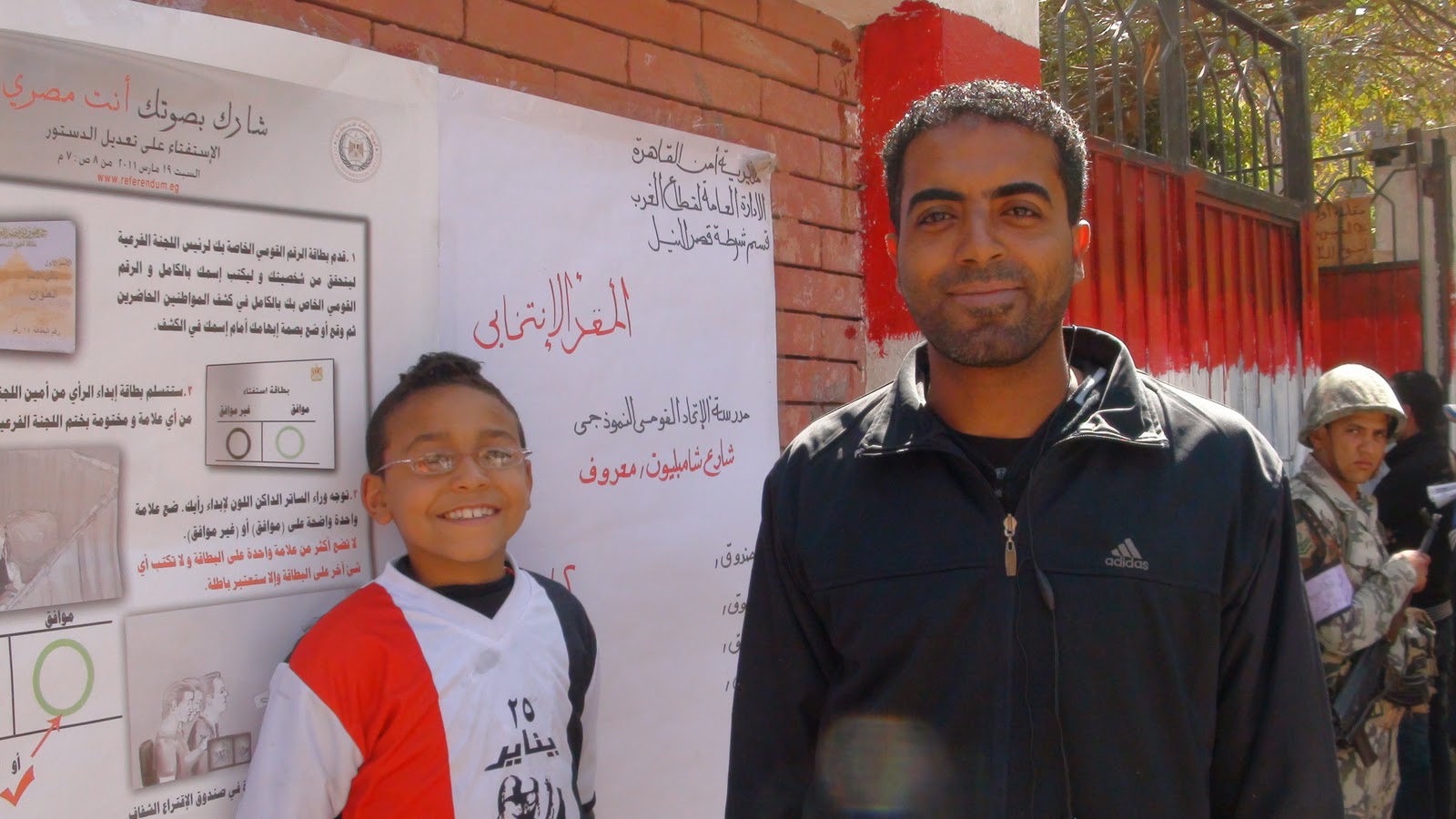
Uncle and nephew in front of a poster which explains the voting process, at a polling station in Cairo, on the 19th of March

At a small elementary school of a popular area, hidden behind a mosque, near the Tahrir Square, at noon, men were patiently waiting in a long queue in the burning sun. One closely next to the other, the long line of male citizens formed all along the walls of the school yard, reached far out through the iron gate and, from there, up a small pedestrian alley in the direction of the mosque. Some of the men were reading newspapers and others making plans aloud about how to reform the country. For the ladies a separate queue was formed which was astonishingly short, compared to the one of their male compatriots. It  never consisted of more than six women at a time.
An armed soldier was keeping guard in front of the iron gate of the school. And at the doors of the polling station, two police men kindly told me that I was not allowed to step further inside. A lady who stepped out to the schoolyard explained to me that there were no officers controlling inside the polling place and that one could freely take a sheet, mark “yes” or “no” and then put it into the ballot box. She showed me her thumb which was marked pink. This is the sign which makes sure that the citizens will not vote twice. However, not all of the polling stations handled this finger-coloring-policy in the same manner. Some requested the index finger and others seemed not to dye their citizens’ hands at all. This somehow made me doubt about whether it was not possible to vote twice, as all Egyptians could vote at whatever ballot box of their choice, in the complete absence of lists and with the tainted fingers as the only direct proof of participation.
Be this as it may, the Egyptian citizens were very happy and proud to be voting for the first time in a referendum in which they directly felt their influence on the shaping of a new political system. Gamal, a law student, told me that he is very pleased that in these times of democracy and freedom the Egyptians are finally asked to think and to decide what they consider good for their fatherland. He added that this is the reason why, starting from now they will be able to fully respect the law for it being passed by the sovereign people.
Next to the iron gate, a big poster hang from the wall formed out of red bricks. It explained how the voting process was to be handled by the individual citizens. Mohamed, the owner of two shops which are supplying car items, proudly explained the meaning of the poster to me, while his little nephew kept posing in front of my camera with his new T-shirt in the colors of the Egyptian flag and with the line “Revolution of the 25th of January” printed on the front.
This was the first really warm day in Cairo since the beginning of the month and people moved happily and proudly around the town, aware of the fact that they themselves had overthrown the system and were on their way to build up a new one; a real democracy, not only rhetorically defined as such by the constitution.

Saturday, 19 March 2011

The People Want a New Constitution!

Yesterday night, while driving home in a taxi, I was already able to collect some propaganda sheets which people handed out along the road. The Facebook group Almasry Alhurr distributed a small flyer in the shape of the Egyptian flag on which, in two columns, they shortly stated what they wish and what they oppose to. The conclusive propaganda slogan reads at the bottom:  “Say “no” to the reform, save your right and the rights of your children!” The taxi driver who observed my eagerness for collecting these sheets and who saw that I was reading the constitution on the back seat, told me that he was feeling quite helpless. He explained that he wants to contribute to the rebuilding of the nation but that he feels that he has not enough information to do so. Therefore, he asked me to explain to him what this constitutional issues were all about. At the same time, he expressed his and the people’s need for political education. 

Tharir Square on the 18th of March, people dancing under the Egyptian flag

At noon, on my way to Tahrir Square, the posters encouraging the Egyptians to vote “yes” at the referendum about the constitutional reform seemed to form the majority. I even witnessed how a man was tearing down the red propaganda sheets posted to the walls by the opposition. Overnight, the town had been plastered in posters with the bold written words “yes” or “no”, a view only familiar to me in this magnitude from my home country Switzerland.
On the Tahrir Square, however, solely the parties promoting the denial of constitutional reforms where represented. Academics were gathering massively and they easily recognized each other. All universities from Cairo and even from abroad seemed to have sent their delegates. This is the reason why, the normal greeting had become: “good morning, Doctor, nice to see you today! Let me introduce my colleague from the University XY to you…”
But not only the professors met on the Tahrir Square today, poets again came up to me in order to recite their work and a bunch of young men enthusiastically let me film their dance under an enormous Egyptian flag while holding up their red posters which were saying “no.”
 Tharir Square on the 18th of March, woman promoting the "no" to the reform of the constitution.
 
People attached to political groups or independent citizens all massively distributed flyers or even newspapers. At the same time, the army and the police were building rows around the different groups of demonstrators who were crowding around the speakers. The officers seemed to be in a good mood. Some of them even started to negotiate the price of revolution-souvenirs with a street seller and another three of them directly asked me to film them. They smiled and lined up proudly in front of my camera.

At 11pm, the political activity on Tahrir Square had still not stopped and “no”-papers were amply flying through the open windows of the bypassing cars.

Will the people vote “no”? Will the elections be fair? A caricature in the newly founded, Medan Altahrir newspaper which was distributed for free, doubts about that.
We will see tomorrow…

Thursday, 17 March 2011

...and the waves of the Nile were dancing with joy…

Early in the morning, I left for Zaqaziq. The weather was foggy and the cars advanced slowly. After an hour some sunrays pierced the mist and finally the formerly black and filigree palm trees adopted their full and dark-green attire.
At the University of Zaqaziq I was invited to attend the meeting of the Students’ poetry club, lead by Prof. Dr. ‘Ali Yusuf as-Sayyid of the Department for Arabic Language and Literature. Twelve students and two professors gathered in an ample office and sat down on the chairs, and behind the tables, lined up along the walls. Four male students and one female student, in their early twenties recited their poems which they had written about the revolution.
Mostly in classical Arabic, each of them performed his/her recital as an act of perfectly dominated passion, proper for professional actors used to stage Shakespeare. The only female student who happily agreed to recite her work, metaphorically pictured the joy of the Egyptian people on the Tahrir square, when they had succeeded to make Mubarak fall, as the waves of the Nile which were dancing.
I was deeply moved by the literary talent and eagerness to acquire knowledge of these young people. The professors finally left the room and the students sat with me for a while in order to ask questions. They wanted to know, why the “West” was often picturing them as cruel and bloodthirsty terrorists and why the foreign journalists had not correctly understood, right from the beginning of the revolution, their wish for freedom and their need for a just and common space where they might develop their talents. At the same time they expressed their desire for an exchange with foreign youths which until now has been more or less impossible in this part of the country.
On my way back to Cairo, I was deeply moved about the scene I had just witnessed. To see how these so highly gifted and intelligent students recited their poems and demonstrated their willingness to learn and get to understand, impressed me much more than all the demonstrations I had witnessed since my arrival in Egypt. Therefore, I said to myself: “These young people are truly able to build up a bright future for themselves and for their country!" 
Will the international power-structure let them do so?

Wednesday, 16 March 2011

Active Period of Political Debate about the Constitution

Recently, a friend of mine explained to me that before the revolution, all what people were talking about was soccer and that now, after the fall of Mubarak’s regime, politics completely are dominating the thoughts and discussions of all layers of the Egyptian society.
As a matter of fact, on the highest level, the political parties started to make propaganda either for a “yes” or a “no” to the reform of the constitution of 1971 which is still in force. The opposition parties (the Wafd, Nasserists and three others are quoted in Masri al Yom) as well as Mohamed El Baradei and his National Union for Change are encouraging their followers to vote “no”, next Saturday, when the Egyptians are asked to proceed to the ballot boxes of their districts. On the other hand, Mubarak’s National Democratic Party –in Masri al Yom quoted without the adjective “democratic” – and the Muslim Brothers promote the maintenance and amendment of the Norma Normarum.
El Baradei does not find it reasonable to perform a voting process in the middle of this politically still chaotic situation and claims for the establishment of a dialogue among the political groups in the first place. At the same time, the Muslim thinker Muhammad Salim al ‘Awa, is quoted by Masri al Yom, as inciting the “ones who truly love Egypt” to agree to a reform of the constitution. He is convinced that in the transitional period until the elections, no new Supreme Law might be passed.
The Muslim Brothers stick to their pre-revolutionary program of rejecting the possibility for Christians or women to become Egyptian presidents. 
Caricature currently exhibited in Cairo Atelier

At the same time, the network of the “Youth of the Revolution” (which consists of uncountable interlinked grass-root organizations mostly connected thorough Facebook) and the army started to rebuild the destroyed church in the village Sawl –the destruction of which had been one of the main causes for the demonstrations in front of the “Maspiro” television tower. The Copts also declared that they do not wish to establish a Christian political party and that they plead for a secular state instead.
It is quite striking to see the Muslim Brothers “ally” with the National Democratic Party as far as the voting on the constitution is concerned. One wonders whether they were not maintaining a certain kind of dialectical dynamic with the regime which has been overthrown by the revolution of the 25th of January. Even though, from time to time arrested by Mubarak’s secrete services, Muslim Brothers were already represented in the Parliament longtime before the revolution. They also joined the demonstrations quite late and still seem to wait and see for further developments before taking a clear position.
A more unmistakable message is transferred by the Islamists who are released from prison. They are convinced about the feasibility and necessity of the foundation of an Islamic state in the sense of the caliphate.

Monday, 14 March 2011

La Vache Qui Rit

Wordplay-Parody Turned into Aesopian Symbol – The Relation between the Valkyrie and Mubarak

Thanks to globalization, the motive of the red laughing cow on the round carton cheese package, has become familiar to the inhabitants of 120 countries. Jules Bel started to produce this milk product by the end of the 19th century on the French side of the Jura. The artist, Benjamin Rabier designed the first laughing cow for the competition organized by Bel who was searching for a product-label.
The name “la vache qui rit” is originally derived from a French wordplay which mocked the food transport of the German army during World War I –called “Walküre” (i.e. “Valkyrie” in French). The divine heroine of the Norse mythology was therefore brutally turned into a happy cow and exposed to laughter in hostile lands.
However, this is not the end of the story: Egyptian Aesopian speech which was aiming to foment resistance against Mubarak’s authoritarian regime during the last decades, integrated the laughing cow into its vocabulary. “La vache qui rit” in written satire and caricature came to represent the ex-president Mubarak.
In conclusion: the Norse divinity Valkyrie was turned into a laughing cow, at the beginning of the 20th century and –in this new guise– came to represent the Egyptian president, one hundred years later. Which means that a logo, designed after the parody of a popular etymology was employed anew as Aesopian emblem of resistance against oppression. In the first place, a symbol of strength of the enemy was mockingly debased, in the second step, the outcome and commercialization of even that parody, was used to degrade a representative of arbitrary and corrupt rule. This is how the happy, red cow successfully laughed about two menacing power- constellations.
On the Opera Square, stands a sign which should draw the drivers’ attention to traffic lights. This somewhat useless indication to traffic lights, which do not exist on or near the square, was turned into the support for a logo of the Mubarak opposition: a crossed-out picture of the laughing cow.

Traffic sign with the "la vache qui rit" anti-Mubarak propaganda sticker on the Opera square

The Caricature and the Revolution

The Caricature and the Revolution” is the title of the exhibition which Mohamed Abla opened today in his gallery “Cairo Atelier” and which will warmly welcome visitors during the next two weeks. Six walls are filled with the satirical artwork of Egyptian as well as American caricaturists. The caricatures are mostly reprints of the originals which were formerly published in newspapers, since the beginning of the revolution.
 
One of the major topics brought forward by the artists is Mubarak’s stubbornness in refusing to step down. The former president is therefore depicted as having the pyramids plug into his ears while facing the demonstrations; as crossing his arms on his chest and saying that he will stay; or as standing in a lake of blood, while insisting to continue his mandate until the bitter end. At the same time, the sphinx with a plaster on her nose and the sharks of Sharm el Sheikh call out that they will remain until he leaves. In another drawing, the people push the tyrant down from his royal throne with a huge “la” (no) or they snatch him away with an enormous arm, composed of the masses of demonstrators. Watches are also symbolically used to display that Mubarak’s time is up: a sand-watch shows his face on the bottom while shoes are drizzling down and menace to drown him. (To call somebody “shoe” is a common and bad insult in the Egyptian dialect, for the shoe also being related to impurity in a socio-religious context).


Another important subject displayed in the caricatures of the exhibition is Facebook. This new medium is metaphorically celebrated as the knight which came to liberate the country or depicted as a gin which jumps out of the computer in front of Hosni Mubarak. A big drawing of “Facebook” is also presented in a caricature as the new “office picture” which managed to ban the omnipresent image of the former president. At the same time, the national personification of the United States, uncle Sam, hesitates whether to “unfriend” Hosni on Facebook. Another satirical drawing shows the sinister representative of the secret service sarcastically gaze at the demonstrators and explain to his ally –the death– that what they have to do now is to make those “friended” people “enemy” each other.


Facebook is generally recognized as having played a main part in the coordination of the protests. However, the voices which insist on the fact that the revolution was truly “popular,” state that when Mubarak’s regime made the internet and telephone system collapse, the people were –surprisingly– still able to gather for demonstrations. As the access to Facebook clearly marks the social status of a person as on the middle and upper class level, the Egyptian revolution of the masses might –in theory– be turned into a movement completely in the hands of the elite. In order to make her position clear concerning this discussion, the first female judge of the Supreme Constitutional Court, Tahany al-Gibali, mentioned in her talk about the constitution, which took place in the AUC today, that the revolution must be considered as a “popular” uprising to which Facebook contributed but which was not solely established by this modern instrument of mass communication.


A third important topic depicted by the caricaturists is the change of attitude of the population towards the police. Amply feared before the revolution, the officers now serve coffee and nicely great the “people” who look down on them. In one satirical painting, a criminal explains in a talk on his mobile phone that he cannot “work” at the moment. Due to the fact that even the police are afraid of the anger of the masses, he does not dare leave his home… 


At the same time as the police is mocked, the army is celebrated as the savior of the freedom of the country. Not only the caricatures celebrate the victory of Tahrir as achieved by the people and the army, even on the streets, while passing in front of the opera, I could witness again groups of young men proudly and happily taking pictures with a tank positioned on the square.

Saturday, 12 March 2011

Muslims and Christians: Two Halves of One United People

The Friday prayer and demonstrations took place in front of the television tower and on the Tahrir Square under the banner of unity between Muslims and Copts. People showed up with crosses and crescents painted on their cheeks. The banner  which were displayed today mostly highlighted the “naturally determined” and, therefore, “national” and “necessary” union among all Egyptians despite of their religious differences. At the same time, the written slogans campaigned against the reform of the old and for the elaboration of a completely new constitution. 
Demonstration for national unity among Muslims and Copts on the Tahrir Square on the 11th of March
On the 19th of March the Egyptians will be asked to vote whether or not they want to accept the old constitution to be emended in order to speed up the election process. People fear that if the old constitution is merely reformed and not completely replaced, the old system which favored widespread corruption and empowered the secrete services, will continue.
The prayer and the political agenda of unity among Muslims and Copts did not attract even half as many people as had been there one week ago. “Where is everyone?”, did I ask a woman who was following the happenings next to me. “Most of them are in front of “Maspiro”, the television tower where the Copts have been protesting for seven days!”
The middle of Tahrir Square was deserted and the circle of sand in the centre flooded with water. An ugly looking swamp was left at the place where only one week earlier poets, activists, preachers, victims and street sellers were still gathering fool of energy and enthusiasm about the revolution.

Demonstration for national unity among Muslims and Copts on the Tahrir Square on the 11th of March

The representative of the Supreme Council of the Egyptian army stood next to a high priest and a monk of the Coptic church. They hugged, kissed the pictures of the victims of the revolution which were handed up to them and sung the national anthem twice with the crowd. The high army officer in his simple uniform held up a Quran and a cross in his hand and had the people repeat that Muslims and Christians are all Egyptians and will rebuild this free new country together.
The scene looked artificial, stiff, exaggerated and therefore unintentionally comic enough to remind me of Adil Emam’s parody of a conference for the national dialogue among Muslims and Copts in his film “Hassan wa Marqus”. In one scene, the representatives of the two major religious groups of the country talk bad about each other before entering the conference hall and then finally –hand in hand–  they stand up after every intervention and call out aloud: “Long live the [union of] the crescent and the cross!”


Later in the afternoon,  a shaykh from al-Azhar claimed out against the corruption of the old system. He accused Mubarak, al-Adly and the former ministers of corruption and reminded the importance of their public trial to the audience who had gathered in front of his stage which was formed by a van and a pile of black amplifiers.
In front of the television building on the Corniche of the Nile, four tanks, barbed wire, iron bars and armed soldiers made the protesters “feel save”. The same slogans were voiced as on the Tahrir Square. However, Muslims seemed not to be plainly happy with the attitude of the Coptic Church. Baba Shenouda III remained loyal to Hosni Mubarak’s regime until its very end. This is the reason why, some of the Muslim revolutionaries now feel that the Christians are trying to profit from a political movement which has not really been theirs.
Even though, in these difficult and uncertain times, the Egyptians have barely lost their sense of humor. Two days ago, I witnessed the performance of folk songs against “Adly Bey”, “Mubarak”,  other representatives of the fallen regime, the baltagiyya and the secret services. Today, I attended a shadow and puppet play which mocked the revolutionary situation and ended by making the children –who were eagerly following the show– sing the national anthem. I am also spending my days laughing about Mubarak and other jokes and my nights looking at the caricatures which are massively published in the newspapers.


Mubarak Joke

For his birthday, Mubarak gets a turtle as a gift. The person offering the animal, tells him that it might live 400 years. Mubarak answers, not really convinced: “Hmmm, we will see about that…”