Friday, 11 March 2011

Building up Democracy?

The new Minister of Culture Emad Abu Ghazi in a reunion with Egyptian theater artists at the Supreme Council for Culture
Today, the new Minster of Culture, Emad Abu Ghazi met a group of about 200 artists in the Supreme Council for Culture in order to listen to their wishes and needs for the future development of the Egyptian stage. The actors, directors, playwrights and other personnel involved in drama activities, eagerly voiced their suggestions and questions. The minister stood in front of the sometimes loud and struggling crowd, took notes and replied to the audience.
Even though, the euphoria of directly addressing the minister and the desire of many people to be talking at the same time sometimes seemed to lead the common approach to chaos, the audience always managed to calm themselves down. Everybody was completely aware of the importance of the moment. The wish for cooperation was held up high explicitly. The perceptive and so easily approachable minister with his audience who brought forward a torrent of ideas, demands and projects set up an atmosphere of constructive and plainly democratic dialogue. 
Tahrir Square on the 10th of March, guarded by the army and the police

Will this spirit of freedom be strong enough to conquer back the public space which for the moment is “over-protected” by tanks and armed soldiers? Will it succeed in holding back the mist of fear which is sneaking out of some deep cellars which are still guarded by the secrete services? Will it fill the air with tolerance and make the Christian and Muslim fundamentalists’ violent agendas vain?

Wednesday, 9 March 2011

9th of March 2011 – The End of Liberation (Square)?

The 9th of March is an important date in Egyptian history. On that day in 1938, the first President of Cairo University, Ahmad Lutfi as-Sayyid, resigned in order to protest against the governmental decision to dismiss Taha Hussein from his position as the Dean of the Faculty of Arts. Freedom of thought and expression were then progressively banished from the campus of Cairo University and this situation  was to last until present day.
During the last three days, students and professors have been openly protesting against their superiors. They want to push the president and the deans –representatives of Mubarak’s regime– to resign. However, the president just decided to maintain Cairo University closed for some more days until everybody might forget about the issue…
College for English Literature of Cairo University; students claim for the re-opening of the university, 9th of March 2011

When I came back from the campus, at around 8 pm, Midan at-Tahrir was empty. Soldiers with machine guns were patrolling the square and a group of around sixty men had gathered in a corner of Qasr al-Nil Street. They were gazing to the centre of the circle where a few hours earlier the “inner-circle of the revolution” had still been operating. Officers of the traffic police in their black winter-uniform and armed soldiers were circling around them.


Administration Building: The Mogamma
The “utopian city of liberation” had completely vanished. The core building of the Kafkaesque authoritarian administration –the Mogamma– had recuperated its sinister totalitarian aspect. It had suddenly, reappeared out of the shadow of the tents under the shelter of which freedom had been born. Was this a dream? Are we to wake up all of a sudden from this short ecstasy of liberation?
The traffic police seems to have recuperated their former positions and are to be seen everywhere in down town. Curfew is –starting from tomorrow– back on at 8 pm. The reason why? The baltagiyya, as usual… 

Demonstration for Women’s Rights


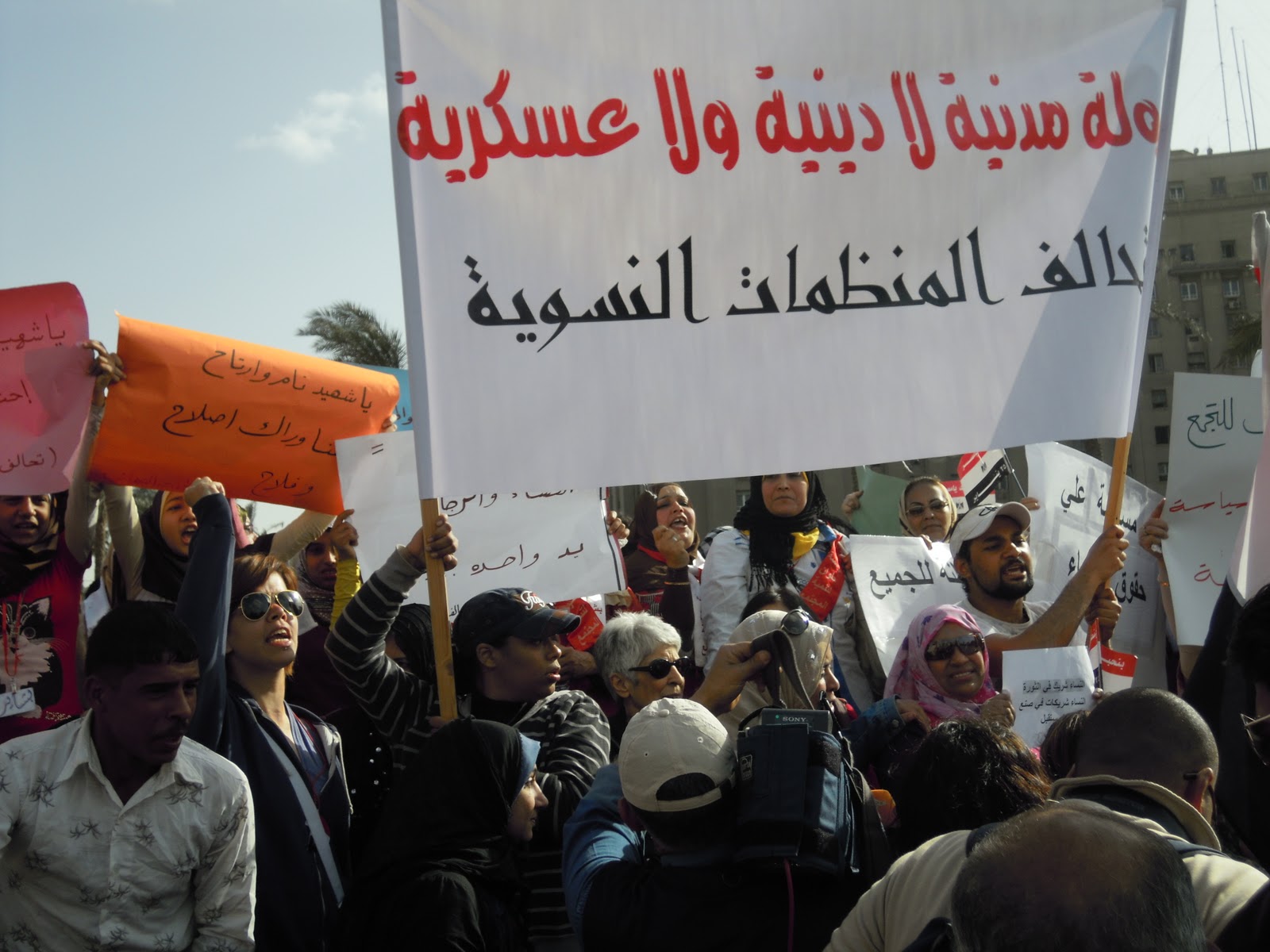
On the 8th of March –International Women’s Day–  the Confederation of Egyptian Women’s Organizations (تحالف المنظمات النسوية المصرية) convoked, like every year, a gathering. However, this time they decided that they wanted to make their demonstration march from the building of the journalists’ syndicate, along Talaat Harb Street, to the Tahrir Square in order to unite there with the steady residents of the “inner-circle” of the revolution. 

8th March Demonstration for Women's Rights

Demonstrations currently happen on a daily basis. The Egyptians need to talk and to scream their thoughts out aloud. People openly lament to have lost thirty years of their lives to a system which had curtailed all kinds of initiative. It seems that now, avalanches of demands and projects which had been held back over the last three decades are continuously discharged into Liberation Square.
Yet, not everybody is happy about the ongoing obstacles of the traffic. To be stuck for hours in the traffic jam and finally not to reach appointments is everybody’s fate at the moment. Nobody exactly knows when and where demonstrations are taking place. Where the traffic police is missing, citizens try to help to put some order back into the chaos of desperately honking vehicles. Sometimes groups of people stop cars in order to tell the drivers which streets presently are closed and which alternative way they might choose instead.
For the women’s rights demonstration, around fifty women and men had gathered in front of the building of the journalists’ syndicate. They assembled on the stairs while a lady handed out Egyptian flags to the participants. Then they briefly posed with their banderoles and posters for the photographers and journalists form the television and finally walked pacifically in their little circle towards Tahrir Square.
Very prominently, one of the organizers walked in front with a bunch of flowers in her arms for the martyrs of the revolution. The attractive tall women with her long black hair and white-framed sunglasses moved proudly on her high-heeled boots and continuously addressed the watchers with a charming smile. “Every man has to congratulate every woman on this day because this is the International Women’s Day!”, she kept repeating. 

8th March Demonstration for Women's Rights

The small group passed in front of the Swiss embassy, where the very young looking soldiers on guard,  with their enormous machine guns, curiously gazed at them. On their way, the protestors were asked about their demands by the people on the streets. Some of the men who were watching the demonstration concluded that they did not really understand “the problem”. Others were wondering what “those foreigners” wanted from the revolution. And finally a group of adolescents yelled that the Egyptian women are the best and most beautiful in the world anyway. 


A group of construction workers, with cigars between their lips, asked one of the girls who was carrying a poster with the line “Equality between Women and Men” what this was all about. She bravely turned around, held up her banner towards them and tried to give a short explanation. Unfortunately, they did not look very convinced after she had walked away. 

8th March Demonstration for Women's Rights

On the Tahrir Square, after the party had made their way through the honking cars, they were eagerly welcomed by the guardians of the steady revolution. “Rights now not tomorrow!”, they were chanting. And the women’s rights protestors answered with the slogan: “We want a civil state! Neither a military dictatorship nor a theocracy!”

Monday, 7 March 2011

What comes after the fall of the system?

Who Is “the People”? 
In the “core utopian city” which has become the symbol of the revolution, interestingly enough, no real headquarters, no explicit party structures and no general councils can be found. A lot of different socio-political demands came to be the spirit of this so heterogeneous but pacific community. The youth who are gathering under the plastic tents insist that they are only representing themselves and do not belong to any defined party.
In an interview, the IT-engineer Ahmad (the name is changed) told me the following when I asked him about the organization of the revolution and of Tahrir Square: “There are people who organize committees. Everybody you meet will tell you: “I am the one who made the revolution come true! I am the president of the organizing committee! The revolution belongs to me!” However, you cannot take those people seriously. There are thousands who were and are still demonstrating. Fifteen parties promoted the revolution together. There are a lot of communities, organizations, movements and websites which organize gatherings and come up with ideas and demands. Even though, we are all talking for ourselves. There have been no elections for representatives who might talk in our name. I will help and ally with anyone who shares the same demands and ideas as I have. I am also truly thankful and indebted to the people who come here and take care of the sick, cook food or bring covers to for us. May God protect them and their children! But nobody has the right to talk in the name of the revolution! The guys you see on the television, with nice suites, who wear ties and look clean are not the ones who fought for the revolution. If their eyes are not read and swollen, they have not been exhausted by the revolution. We have a lot of demands, a constitution and the rule of law. I think that there should be a supreme [constitutional] council of five two seven deputies. As soon as we have got a political organ like that, a new constitution can be drafted and we have already made half of our way.” 
Sticker imitating the Egyptian car number plates. Instead of a city, they say: “based on the Tahrir”. Presently to be found on the windows of every second car.
 
Something similar was told in the meeting of the High Council of Culture which I attended some hours later. Here the nicely dressed doctors and professors of constitutional law talked not less revolutionary –but this time mostly in classical Arabic and not in dialect– about political change. One professor insisted, that the situation here can neither be compared to the May 68 movement in France, nor to the post-soviet changes of the Eastern European republics. Another –this time female professor– energetically asked why the break has not come earlier; how the system can still continue when all of the people are against it; why the whole legislative backbone of the old regime is not completely removed and replaced. She was the only one to get a spontaneous and loud applause from the audience after her absorbing intervention. A third dignitary in his seventies added that one should keep in mind that the Western democracies are far from being as perfect as they pretend to look. The English hate their Premier Minister, according to him, and the Europeans do not vote whether they want to have troupes in Afghanistan or not. At the same time, he concluded that the USA can´t be taken seriously with their completely fascist behavior.
In whatever surrounding, whether in formal conference-rooms –from which Mubarak’s pictures suddenly disappeared– or in coffee-houses, people eagerly read the newspaper, discuss and reconstruct the country in their minds.
However, what kind of political system will they finally establish? Will the poem-reciting intellectuals with their Palestinian scarves and cut T-shirts, the justice-seeking injured of the lower levels of society, the crying mothers who lost their children as martyrs on the first days of the upheaval, the furiously preaching bearded shaykhs with their long galabiyyas, the women who are wearing the Egyptian flag as a niqab and the lawyers, doctors and professors who are discussing different political systems and constitutions be able to tolerantly live in a new Egyptian democracy?

Sunday, 6 March 2011

As if they had come from Imagination...

Translation of a new poem (qasida) by the poet Muhammad Ibrahim Abu Sina. The poem is dedicated to the revolutionaries of the 25 of January and was published in Shabab at-Tahrir (a supplement of al-Ahram) on 3 of March 2011. The original Arabic text is wrapped around the Illustration on the picture. 
Click on the pictures to enlarge.

Saturday, 5 March 2011

Friday Prayer and Demonstrations on the Tahrir Square


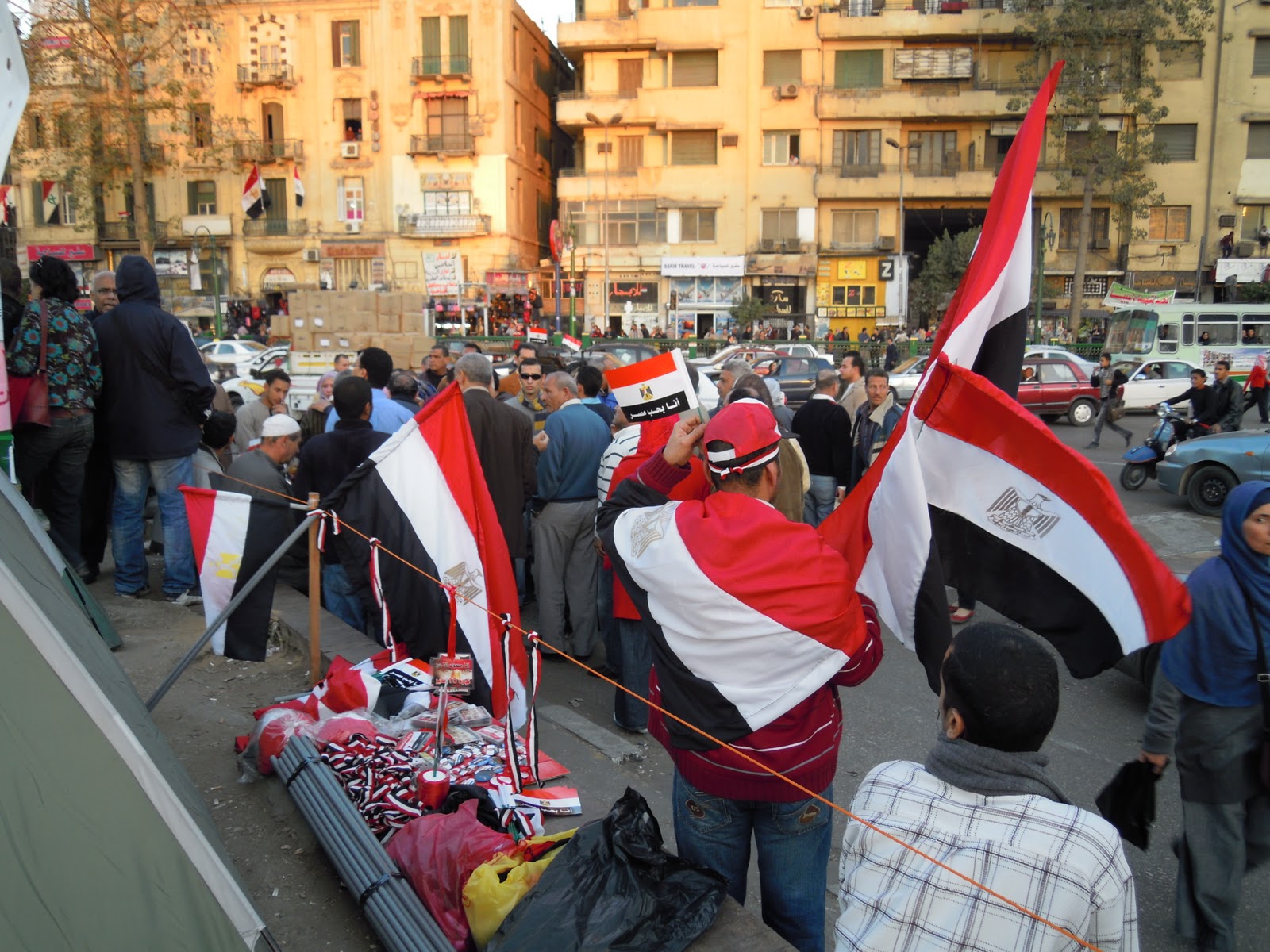
At 9:30 pm I left the house and started walking towards Tahrir Square. The streets were still quite empty. The people selling nationalistic emblems and souvenirs started to set up their posts and young men where offering bunches of red-white-black colored flags to the cars passing by.
By the end of the streets leading to the square, the civil control which the Egyptian Youth of the Revolution is organizing by their own initiative, was already performing the body-check of the ones who attempted to access Midan at-Tahrir. The young lady with her blue, glittery headscarf who was in charge of me, took a glimpse into my bags, smiled at me and let me pass.

The square looked again like at the beginning of a huge festival. People were selling nuts, drinks, T-shirts, flags, bags, badges, hats and all kinds of other gadgets with nationalistic logos. The men painting Egyptian flags on people’s faces were loudly advertising their service while holding three glass bottles in their hands with the colors needed.

Men and women went to deposit flowers in front of different memory-walls dedicated to the martyrs which consist of big white blankets decorated with pictures, spread out around the “utopian perfect city” of the steady revolutionary front, in the middle of the square.
Different stages were set up. Music was playing loudly from all directions. People started to line up for the prayer and men who were selling “one-use” prayer carpets were busily passing through the masses.
Wherever people saw me film, they came along and wanted to tell their story. Some of them said jokingly: “Ah you are from Switzerland, so you have got all Hosni’s money at the moment!”“I will bring it back to you, tomorrow!”, I replied with a smile. This was obviously not the only joke which was told on the square. The Egyptian taste for satire is omnipresent. A puppet-player who was carried on shoulders was holding-up a Mubarak-marionette and making it move pleasingly while a teenager was calling out the rhymed lines which people had to scream at the puppet.

People gathered around me with huge posters which lamented the decease of martyrs, promoted change and freedom and attacked corruption. Some of them carried newspapers and pointed at articles which talked about the revolution. Still, the Egyptians not only seemed to worry about their own future but already showed solidarity with their neighbors who are desperately fighting for freedom at the moment. This is the reason why quite a lot of Libyan flags and posters against Gadaffi’s iron regime could be seen on the Tahrir Square today.
All classes of Egyptian society were present. A group of women in black and wearing niqab loudly screamed on one side while the protectors of the “core utopian city” in jeans and with their Palestinian scarves around their heads where watching. Children were happily dancing, playing with flags and singing nationalistic songs. Elderly people were sitting on the small stone walls or leaning against the green iron fences which border Tahrir square.

Today, I had the privilege of being offered two balconies to film for free. Both of the apartments belong to people who have been giving support to the demonstrators since the beginning of the revolution.
The view of the thousands of people lined up in rows, side by side, women and men, poor and rich, old and young who were following simultaneously with the movement of their bodies the prayer of the Imam was astonishing. I held my breath and scarcely noticed how the sun was burning my face.

After the solemn prayer had come to an end, music started and people chanted nationalistic slogans anew.  Suddenly, the new Prime Minster Essam Sharaf appeared among the masses, only protected by a few soldiers and constantly interrupted by the demonstrators. He started his talk by lamenting not to have been able to attend the Friday prayer on the square. The new Prime Minster then remembered the families of the martyrs of the revolution. In the middle of the crowd he confessed to his people that his task will not be easy. He further assured them that whenever he feels that he cannot master his duty, he will come back to them to the square. According to him, a free and secure Egypt is the highest of his goals and he therefore promised that the security forces will back up the Egyptians. Essam Sharaf solemnly concluded his first speech to the nation by saying that the Egyptians had just won a small Jihad but that the most difficult Jihad was still to come: the reconstruction of the Egyptian state.


I left the square when the sun was starting to set. Some blocks away, when the streets had become less crowded, I passed a father who was holding an around three years old child by his hand. The small boy who had the Egyptian national colors painted on his cheek was waving with a tiny flag and happily chanting all to himself in perfect rhythm:  "The people want the fall of the system!" (as-shahb yurid isqat an-nizam).

Friday, 4 March 2011

The New Bogyman: Al-Baltagy


Egyptians now currently complain about the lack of safety. On the one hand, a taxi driver today told me smilingly that hundreds of qism ash-shurta (police stations – where people used to be tortured) were burnt during the revolution. This is the reason why most of the police-officers flew and only the traffic-police is operating at the moment. On the other hand, people –especially the ones who are living in the popular neighborhoods– constantly express their fear of the baltagiyya.
Al-baltagiyya mostly means crimes of illegal and violent appropriation of someone else’s belongings like robbery or burglary. However, the baltagy seems also to operate as some kind of contractual killer or violent punisher who might be hired against an enemy. The squadrons liberated from prison which Mubarak’s regime sent out against the demonstrators where composed of this kind of criminals.
Be it as it may, the main function of the baltagy, at the very moment, seems to be the one of a bogyman who might come and punish the youth who are starting to behave in quite too liberal a manner for the taste of the traditional, patriarchal families… 

The youth are the heroes of the day. They have made the revolution succeed. Because of their patience to camp even in the rain and cold the old patriarch was chased away from power. How can their parents prevent them now from leaving the family home and from proudly doing whatever they please? The baltagy might catch them!!!


Text: “The Absence of the Police”, [the boy says to his parents]: "I have found out that the security is not stable in the country and as my dad refuses to go out, I will go!!"

Source: al-Masri al-Yom, 02 March 2011, p. 15.

Long Forgotten Tyrants...

The issue of Masri al Yom, published on the 2nd of March, starts with the heading: “The Banks are Starting to Freeze Mubarak’s Accounts and the Ones Belonging to the Members of his Family…” The recently overthrown president is then –one might already say “as usual” –accused of corruption and dictatorial ruling.
Very much to my surprise, after turning the cover-page, I immediately spotted the painted bust of a very familiar personage: Khedive Ismail (r. 1863-1879). This column on the head of the second page of the journal is usually dedicated to historical memory.
The same day as the one on which the newspaper is issued is linked to a date in the past which witnessed an important event in Egyptian history. The title of the column therefore consists of a date, here spelled: “1895.3.2”. Then the explanatory subtitle reads: “Decease of Khedive Ismail, the Founder of Modern Egypt.”
In the article the extravagant despot who was ruling Egypt at the end of the 19th century is highly praised for his uncountable achievements in modernizing the country. According to the brief text Khedive Ismail traveled to Italy after his deposition and finally died in Istanbul. Not a single word is said about the reason why; neither is his “travel to Italy” called “exile”!
The Khedive Ismail truly had Cairo and Alexandria re-constructed, theaters opened, the railway established, the Suez channel constructed and schools and scientific institutions built. Nevertheless, his financial policy of big-spending and taking up loans from English and French creditors drove him to bankruptcy. His tax-system became so cruel that the population on the country-side starved massively if they were not sent to prison and tortured for not being able to pay. Ismail’s merciless fiscal policy nevertheless –mainly due to corruption– did not succeed to pay back the loans and the financial dependence from the European powers finally was one of the main causes of the British occupation.
During his reign, the Khedive was strongly opposed by journalists like Yaqub Sanua, Adib Ishaq or Abdallah Nadim. In 1879 he was finally replaced, unfortunately not because of a national revolution, but due to the pressure the European powers had put on the Sultan of the Ottoman Empire.
Now, 116 years after his death, after a quasi non violent national revolution, the Khedive Ismail is finally put on the pedestal of a founding-father of modern Egypt. In this example Benedict Anderson’s idea of how communities retroactively “imagine the nation” or better “reinvent a national history”, becomes pretty obvious…

I wonder in which way history will be told 116 days after Mubarak’s death? Will he reappear as the poor Mubarak who heroically fought against Israel, finally deposed for a bit of corruption and completely deprived of his honor?    

An-Nukta: Mubarak Joke of the Day

Mubarak enters paradise and meets Sadat and Nasser. They then discuss the means by which they were killed. Nasser tells his companions that his decease was caused by poison. Sadat then explains that a shouting had made him die. Mubarak thinks for a while and then concludes that Facebook dug his grave.

Thursday, 3 March 2011

"I am Egyptian, I am free!"


On the badge is written: "I am Egyptian, I am free" and on the pin: "Hold up your head, you are Egyptian!"


Announcement for the women's demonstration for democracy which will take place on the 8th of March. The participation of one million people is projected.

Liberation Square (Midan at-Tahrir)


At the moment, when approaching Tahrir Square, one might get the idea that the Egyptian national team must be playing in the Soccer World Championship. Everywhere street-sellers offer different items in the colors of the Egyptian flags, even the hats, which are typical for soccer fans and other kinds of gadgets with football symbols, can be purchased. However, the more the visitor comes nearer, the clearer he/she can see that the souvenirs, which are sold, are labeled after the “Revolution of the 25th of January 2011”. Pins are decorated with the line “Hold your head up high, you are Egyptian” and Plastic badges are sold with the pictures of the “Martyrs of the Revolution of the 25th of January 2011”. 

Even though the cars are driving around the square again, the middle is still occupied by the remains of the victorious revolution. In order to get access to this sandy circle covered with tents, one has to pass a body check organized by the demonstrators themselves, which is similar to the one at the airport. A girl with headscarf very naturally passed her hands over my breasts and hips and then let me in. The setting looked similar to an open-air concert at its beginning or end: people peacefully sitting around in tents, children getting their faces painted with the colors of the Egyptian flag, men selling different kinds of nuts but also eggs and other kinds of food and two men repairing a water pipe.

However, something is strikingly different. Poor people, with dirty galabiyyas (traditional long dress) are sitting next to men in suites. Women who are wearing niqab (face-veil) are carrying their children along next to a modern style igloo-tent, where a girl in jeans is eagerly typing on a laptop while the setting sun is making her hair glow with a red shine. On every face, whether poor or rich, sitting under dirty blankets or in a clean lycra tent, shines the national pride. 
These are the people of Liberation Square, the youth (even though there are people of every age) who have just proved to the whole world, that revolutions can be won pacifically. Children are smiling at me and ask me to take pictures of them. Afterwards they want to see them and then proudly walk away. People approach me and ask whether I am a journalist in order to make their stories public. Men and women are carrying all kinds of painted banderoles and posters, which request different kinds of changes. Flags and medallions are carried around which promote the union of Egyptian Muslims and Christians by the symbol of the crescent, which surrounds the cross. A column of memory pays tribute to the martyrs of the revolution. Everybody is friendly smiling and enormously proud to be a part of history. The spirit to fight for social and political changes is very high and people spontaneously gather in small groups and cheerfully chant slogans and walk to the buildings which host the institutions targeted for reform.

“I am Egpytian, I am free: Revolution of the 25 of January” is written on some badges which are sold and as the general mood is so energetic and happy, even a Khawaga (foreigner) like me can easily get 50 Piasters off when buying nationalist symbols. Something else is the rental of balconies for filming. This has turned into a very lucrative business. We entered a shop and asked whether it was possible to get access to the roof-terrace of a building in order to film the Friday demonstrations. The person at the entrance acted as if he did not know what we were talking about but very insistently sent us to the manager of the building. This happened to be a bearded old man, who was wearing a black galabiyya and was counting receipts on his small table, which was squeezed into some kind of mini-office under a staircase. The place, even though tiny, was adorned with all kinds of religious decorations. The manager told us that for 500 Egyptian Pounds a day we could get the terrace and that this was still cheap, considering that last week he was still getting 1000 Pounds from the big international news-channels …

Cleaning the Egyptian Nation

Each time I arrive in Egypt, everything is different. However, never Egypt has changed as much as this time, after the revolution of the 25th of January 2011. On my arrival, the airplane was shaken by some turbulences before landing and meanwhile I was watching the majestic, beautifully illuminated mosques. Egypt looked quiet from high up in the sky. What aspect will it have from down there?

Back in Germany, at the first look, the revolution seemed to be full of contrasts. In a somehow absurd manner, different worlds were displayed next to each other. There was the “real world”, the one which the demonstrators lived on the Tahrir Square and which was transmitted with impacting images. On the other hand, an “artificial scene” was set up discursively by people commenting on the happenings. 

When I was following the events on Egytube, at the very beginning, on the first Tuesday of the revolution, the contradiction between what was going on the Tahrir Square and the comments which were streaming on the internet next to the life images were quite surprising. While enormous crowds of people were protesting in the heart of Down Town, the online comments on Egytube started (in the colloquial sms-Arabic style which is spelled in the Latin alphabet) to switch to a conversation about with what kind of contract and which telephone-company the news channels were best visualized on the new i-phone. This conversation was interrupted by all kinds of nationalistic slogans. 

The contrasts of the Egypt on the streets and the “safe worlds apart” continued. While the images of the Egyptian museum were shown and the furious protesters in the background, a completely overdressed reporter with ravishing, shiny and long black hair continuously insisted upon Egypt being the mother of civilization.
The climax of the absurd was definitely reached with the then still President Mubarak’s last speech. While the Egyptians were holding up their shoes and screaming that he should step down, he explained to the world –unshaken as it seemed- that all of this was not meant against him, that he did not take it personally…

Did these contrasts vanish after Mubarak’s disappearance? What does Egypt look like right now? 

On the plane I started to read the Masri al Yom newspaper and was very excited to see that, at the moment, the revolution seems to succeed. The army promises to hand over power to a civil government on the first of October after the completion of the parliamentary elections which are to be held in June and the elections of a new president which are scheduled for August. The new president shall have a mandate for four years with one possible re-election only. If the army really steps back in October, Egypt will have a civil government for the first time since 1952! This quite reminds me of the so-called “Harakiri del Bunquer” in Spanish history where the dictatorial, fascist executive voluntarily dissolved itself and gave way for a democratic future of the country after Franco’s death in 1975. As a matter of fact, regarding the charges of financial crimes against the Mubarak clan, the army already informs that it will not take part in any of these procedures because there is “nobody above the law.” Even though by this attitude, the army might also try not to get involved into further debasing the honor of the former highest officer Mubarak, the explicit promotion of the rule of law as a universal principle is an extremely important statement.

Mubarak’s pictures published in the newspaper are now said to be “coming from the archive” or “to have been formerly published”. All masks are washed away. Not only the ones which had so long disguised the face of this never aging Dorian Gray of the recent Egyptian history, also the streets are held as clean as it may be. The Egyptians took over their country and are polishing it right now. On the cover-page of Masri al Yom a big advertising from a DSL-operator makes publicity for voluntary public cleaning actions of the streets of “our Egypt”.
Even the taxi driver proudly told me that Egypt was being held clean now. This reminded me of one of the points which Misr al-Fatat were demanding from the Khedive Ismail in 1879 during the very first nationalist movement: they claimed that it should be forbidden for ships to throw waste into the Nile. Nationalism is therefore directly associated with cleanliness. All remains of the misdeeds perpetrated by the fallen regime are washed away and a purified image of the nation arises from the ruins. 

"Clean Egypt 2011"


I arrived in a new Egypt, which seems to be on its way to finally belong to the Egyptians who are organizing themselves democratically in grass-root communities wherever institutions are missing or decisions are being taken slowly. Improvisation also plays a big part in this. To give an example: whereas schools are still closed in Giza the ones of the Cairo side of the River Nile are already operating again. In order make their children not miss more classes, the parents therefore decided to hide the label of the school buses in order to make the pupils pass unnoticed.


The contrasts start to be washed away and the Egyptian spirit for improvisation and the will for survival are set free. How will it continue? I am proud to be a witness of life history during this month of March.